
Graduating and entering the workforce is a strange experience right now. On one hand, the job market for new graduates has tightened recently, with new-grad unemployment reaching 5.7%. On the other hand, starting salaries for technical majors…like computer science and engineering…are projecting healthy gains, nearing or exceeding $90,000 (FYI – cybersecurity hits around $130,000!).
It’s a mixed bag, which means you can’t afford to just throw your resume into the void and take whatever sticks. The secret to landing a great job after graduation isn’t about maximizing your starting salary, nor is it about blindly “following your passion” into credit card debt (AMEX doesn’t accept hugs or promises).
It’s about finding the ultimate intersection: your abilities, your interests, and your total compensation.
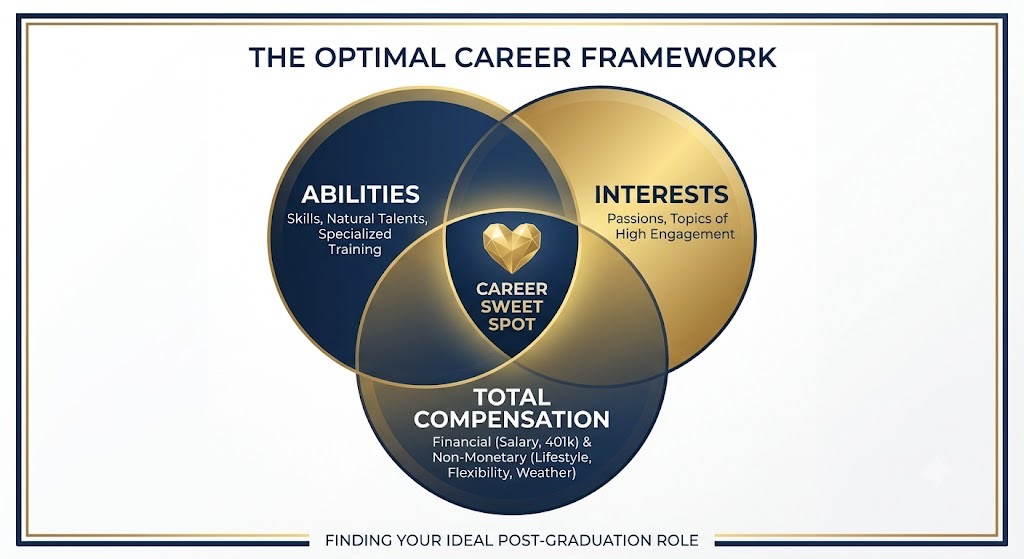
1. Abilities: What are you equipped to do?
This circle represents your hard and soft skills. It’s the sum of your major, your internships, and your natural talents. You might be a phenomenal writer, a data-crunching wizard, or a natural project manager. Identifying your abilities means being ruthlessly honest about what you are currently good at (and what you have the baseline talent to learn quickly).
2. Interests: What actually holds your attention?
If abilities are how you do the work, interests are why you do it. This circle represents the topics, industries, and daily tasks that you genuinely enjoy. You might have the ability to build financial models, but if you have zero interest in corporate finance, doing it for 40 hours a week will lead to rapid burnout. If you don’t like something, the money will only keep you there so long.
3. Total Compensation: How does it fund your life?
This is where most recent graduates make a critical mistake: they look at the base salary and stop there. To find your true sweet spot, you must view total compensation as a two-sided coin that includes both the financial and the non-monetary aspects of your lifestyle.
| Category | What it Includes | Why it Matters |
| Financials | Base salary, signing bonuses, 401(k) match, equity | Pays off student loans and builds wealth. Keep cost of living in mind—cities like Birmingham and Tampa offer high affordability and strong wage growth for new grads. |
| Lifestyle & Flexibility | Hybrid/remote options, flexible hours, PTO | Flexible scheduling is deeply valued and prevents early-career burnout. |
| Location & Environment | Geography, local weather, commute times, city culture | High pay doesn’t fix your mood if you hate freezing winters or despise a two-hour daily commute. |
| Growth & Wellness | Professional development, wellness stipends | Direct investments in your mental health and future skill sets are top-tier non-monetary perks. |
Understand the Trade-Offs
Every job offer requires a slightly different balancing act. If you want to see how shifting your priorities changes your ideal job profile, experiment with the alignment calculator below:
Finding a great job is a highly personal equation. When you align what you’re good at, what you care about, and the holistic lifestyle you want to live, you stop merely surviving the 9-to-5 and start actually building a career.