
The Big 5 Personality Traits
You are treating your child’s elite university experience like a blue-chip asset, pouring hard-earned assets into tuition, admissions consultants, and premium off-campus housing. Yet, many high-achieving parents completely ignore the underlying psychological operating system that dictates whether this investment yields a dividend or ends in a collapse.
The university cartel provides a world-class luxury brand, but it offers near-zero executive functioning support. To protect your investment and your child’s well-being, you need to understand the architecture of their behavior. In behavioral psychology, this is known as the Big Five Personality Traits (OCEAN). Originally developed in the 1950s and refined for decades, this framework remains the most empirically validated blueprint for understanding human behavior, academic success, and resilience.
Here is the executive summary of the Big Five, how the pandemic warped these metrics, and how to operationalize this data for your college student.
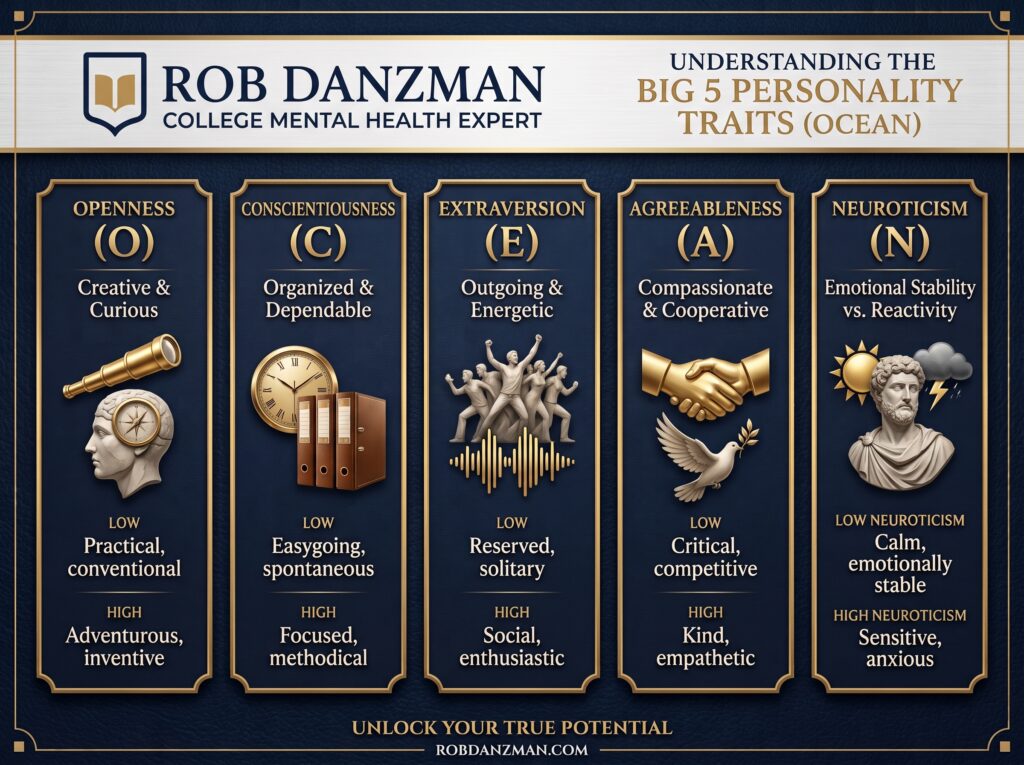
The Big Five (OCEAN) as a Diagnostic Tool
1. Openness (The Innovation Metric: Inventive/Curious vs. Consistent/Cautious)
Big
Students high in Openness are the innovators. They don’t just tolerate the unknown; they seek it out. A student high in this trait doesn’t just do the required reading; they show up at the professor’s office hours to debate the premise of the syllabus.
- The Risk: They can become easily distracted by the shiny and new, abandoning core requirements for intellectual side-quests.
- The Strategy: Leverage their curiosity into structured undergraduate research or diverse internships to keep them engaged, while enforcing rigid boundaries around mandatory, unglamorous coursework.
2. Conscientiousness (The ROI Predictor: Efficient/Organized vs. Extravagant/Careless)
If there is one trait that predicts college and career success, it is Conscientiousness. High-C students are the planners. They use calendar blocking, they submit work early, and they possess the discipline to prioritize long-term goals over short-term gratification.
- The Risk: Low-C students placed in the high-autonomy environment of a modern university will drown.
- The Strategy: You cannot just tell your low-C student to “try harder.” They need external scaffolding. This is exactly where my tailored counseling and consulting services step in. We don’t just talk about feelings; we build the external architecture—rigid study workflows, ongoing academic monitoring, and accountability loops—until the student internalizes the structure.
3. Extraversion (Social Capital: Outgoing/Energetic vs. Solitary/Reserved)
Extraverts derive energy from external stimulation and social interaction. They are the networkers, the study-group leaders, and the campus connectors.
- The Risk: FOMO (Fear Of Missing Out) can severely cannibalize their deep-work time. Introverts, conversely, may isolate themselves and fail to build the necessary social capital for career advancement.
- The Strategy: Extroverts need forced “monk mode” hours built into their week where devices are off. Introverts need quantifiable social goals, like attending two networking events or clubs per month, to ensure they aren’t completely invisible.
4. Agreeableness (Team Dynamics: Friendly/Compassionate vs. Critical/Rational)
Highly agreeable students are empathetic, cooperative, and value harmony. They make phenomenal roommates and team players.
- The Risk: They often lack boundaries, taking on the emotional baggage of their peers or failing to assert themselves in group projects and salary negotiations.
- The Strategy: Teach them the tactical application of the word “no.” They need to learn that setting boundaries is not an act of hostility, but a requirement for self-preservation.
5. Neuroticism (The Volatility Index: Sensitive/Nervous vs. Resilient/Confident)
Neuroticism measures emotional stability and risk-aversion. A student high in neuroticism is highly sensitive to stress, prone to anxiety, and easily overwhelmed by negative emotions
- The Risk: Paralysis. When the friction of college hits—a bad grade, a breakup—high-N students spiral rather than pivot.
- The Strategy: This requires clinical intervention, not parental lecturing. High-N students need evidence-based coping mechanisms (CBT, DBT) to lower their baseline anxiety and reframe failures as data rather than existential threats.
The Pandemic Hangover: A Shift in the Baseline
The 2020 global pandemic was an unprecedented stress test on the developing brain, and it fundamentally altered these baselines for the current cohort of college students.
- Spiked Neuroticism: The chronic uncertainty of the pandemic hardwired a heightened state of anxiety and emotional distress into an entire generation.
- Atrophied Extraversion: Years of social distancing and digital-only interactions crippled the organic development of social skills. We are seeing a profound deficit in students’ ability to navigate face-to-face conflict or build authentic relationships.
- Fractured Conscientiousness: When schools dropped standards and eliminated deadlines during the pandemic, they accidentally trained students to have a fixed, low-effort mindset. Adapting back to rigorous, high-stakes environments requires a major recalibration of their discipline.
Operationalizing the Data
Understanding your student’s Big Five profile is useless if you don’t apply it. You cannot force a highly neurotic, low-conscientiousness student to suddenly become a resilient, hyper-organized machine through sheer willpower.
They need a system. Through my consulting and counseling services, I act as the objective, third-party buffer between your student’s struggles and your parental anxiety. We assess the student’s operating system and build a customized Semester Blueprint. We manage the friction, implement the executive functioning tools, and provide the clinical support necessary to navigate the volatility of the college years, allowing you to return to being a supportive parent rather than a frustrated project manager.
Summary
Here’s your cheatsheet for the Big 5 personality traits and how they relate to the college experience.
- Core Concept: The Big Five personality traits (OCEAN: Openness, Conscientiousness, Extraversion, Agreeableness, Neuroticism) provide an empirically validated framework for understanding and predicting college student behavior and academic success.
- Conscientiousness as ROI: Conscientiousness is the strongest predictor of academic and career achievement; students lacking this trait require external executive functioning scaffolding (e.g., calendar blocking, structured accountability).
- Managing Neuroticism: High neuroticism correlates with high anxiety and emotional volatility; these students require evidence-based clinical support to reframe setbacks and manage stress.
- Pandemic Impact: COVID-19 significantly altered student baselines, generally increasing Neuroticism (higher anxiety), decreasing Extraversion (reduced social skills), and fracturing Conscientiousness (poor adaptability to rigorous deadlines).
- Career Alignment: Personality traits should inform career choices. High Openness aligns with innovation/arts, high Conscientiousness with finance/law, and high Extraversion with sales/leadership.
- Intervention Strategy: Parents should utilize specialized counseling and consulting services to assess a student’s Big Five profile and implement a customized “Semester Operating System” to ensure academic success and mental well-being without relying on parental micromanagement.