
The $350K Seed Round: Why Your Freshman is Failing the First 30 Days (And the KPIs to Track)
You just wired $85,000 to an institution with an endowment larger than the GDP of a small nation. You survived the hyper-competitive admissions gauntlet, bought the premium dorm essentials, and tearfully drove away.
Let’s look at the tape: You’ve just made a multi-hundred-thousand-dollar seed investment in a startup with a sole founder—an 18-year-old whose prefrontal cortex won’t finish baking for another seven years. The parental scaffolding that got them into a top-tier university is suddenly gone. No guardrails, no mandatory wake-up times, and unregulated access to infinite dopamine.
Here is the harsh clinical reality. The first 30 days of the Fall semester dictate the trajectory of the next four years. If things are going to go off the rails—clinically, academically, or socially—the fissures almost always appear in this critical window.
Most parents hope for the best. High-achieving families don’t rely on hope; they rely on data, strategy, and systems. If we treat elite higher education like the massive capital allocation it is, we need to track the right metrics.
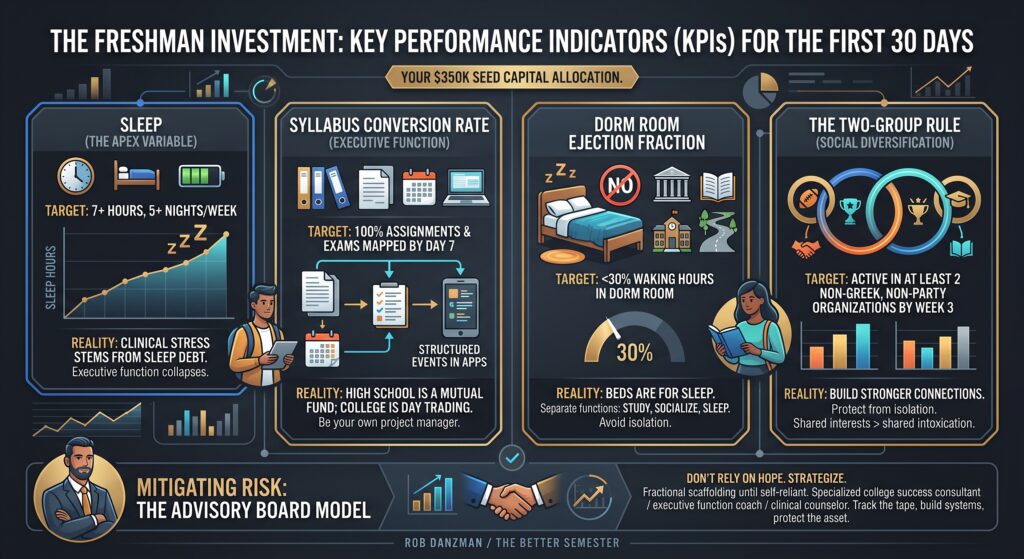
Here are the Key Performance Indicators (KPIs) you need to be monitoring during your freshman’s first month on campus.
KPI 1: The Sleep Metric (The Apex Variable)
- The Target: 7+ hours of sleep, 5 nights a week.
- The Reality: We talk a lot about the “mental health crisis” on campus. But in my clinical and consulting experience, 80% of what looks like a primary mood disorder in October is actually just a sleep debt compounding at a predatory interest rate. When sleep hygiene collapses, executive function goes with it. The brain loses its ability to regulate emotion, prioritize tasks, and manage stress. Full stop.
- The Check-In: Don’t ask, “Are you sleeping?” They will lie to you…and they will lie to themselves. Ask, “What time did you finally put your phone down last night?“
KPI 2: The Syllabus Conversion Rate (aka. Executive Function)
- The Target: 100% of major assignments and exams transferred to a master calendar by Day 7.
- The Reality: High school is an actively managed mutual fund; teachers are the fund managers. College is day trading. The transition is jarring. Your freshman is now their own project manager. By the end of the first week, every syllabus should be dissected and mapped out on Google Calendar, Notion, or a physical planner. If they are keeping their assignments “in their head,” they are already bankrupting their semester.
KPI 3: Dorm Room Ejection Fraction
- The Target: Spending less than 30% of their waking hours in their dorm room.
- The Reality: The dorm bed is a depreciating asset and the enemy of mental health (except for the 7+hrs/night we discussed earlier). The algorithm of a successful college transition requires the geographic separation of functions. You sleep in the dorm. You study in the library. You socialize at the frat house. When kids start studying, eating, and binge-watching TikTok in their beds, isolation sets in. Anxiety spikes. If your kid is retreating to their room immediately after class, the warning lights on the dashboard should be flashing red.
KPI 4: The Two-Group Rule (Social Diversification)
- The Target: Active attendance in at least two non-Greek, non-party organizations by Week 3.
- The Reality: The biggest threat to your investment isn’t academic failure; it’s social isolation. Young adults are starving for connection, but the wrong social integration is just as dangerous. Rushing a fraternity or sorority is fine, but their identity portfolio needs diversification. They need a club sport, an academic society, a debate team, or an investment club. They need structured social environments where connection is based on shared interests and shared struggles, not just shared intoxication.
Mitigating the Risk: The Advisory Board Model
Look, you don’t build wealth or a successful career by leaving high-stakes transitions to chance. When corporations face a massive restructuring, they bring in consultants. When a CEO is struggling, the board hires an executive coach.
Yet, when we send our kids off to navigate the most complex social and executive functioning transition of their lives, we cross our fingers and wait for a midterms crisis call. We tell them to “go to the campus counseling center”…a notoriously overwhelmed system with a six-week waitlist.
If your freshman is showing early signs of executive dysfunction, crippling anxiety, or failure to launch in those first 30 days, waiting until Thanksgiving is a terrible strategy. High-achieving families understand the value of an advisory board. Bringing in a specialized college success consultant, an executive function coach, or a private clinical counselor before the wheels come off isn’t helicopter parenting…it’s intelligent proactive risk mitigation.
It’s providing the fractional executive scaffolding they need until they can build their own.
The first 30 days are the crucible. Track the tape. Build the systems. Protect the asset.