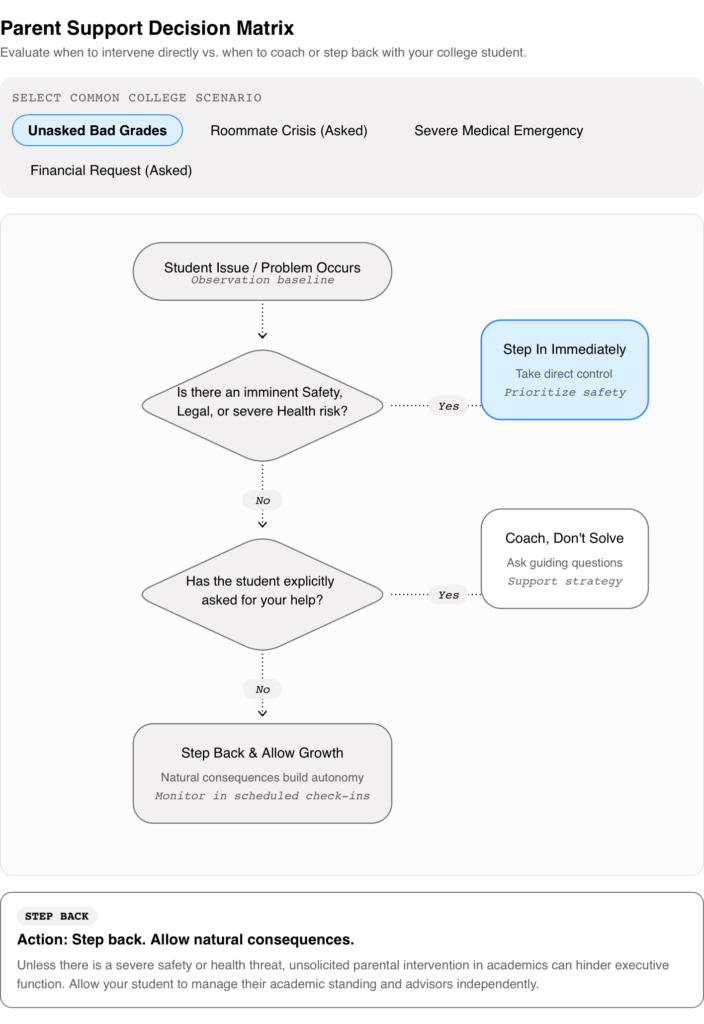
You’ve spent 18 years engineering their success. You’ve invested heavily – financially, emotionally, even operationally – to get them to this exact point. But here’s the hard truth about the college transition: your involvement is now experiencing rapidly diminishing returns. What’s changed??
The college transition is a developmental earthquake. Every pillar of a student’s identity gets tested. As parents of high-achieving young adults, your instinct is to jump in, manage, and snowplow the friction out of their way. Don’t. Removing gravity leads to muscle atrophy, and solving all your college student’s problems atrophies their grit. We need to raise anti-fragile young adults who can manage setbacks, improve with friction, and not just check boxes on a résumé.
It’s time to shift from solving to coaching. Here are evidence-based strategies for identifying, setting, and maintaining boundaries during the semester and those messy holiday breaks.
1. Identify: The Cost-Benefit Analysis of Intervening
Parents need to do a brutal cost-benefit analysis before jumping in. Ask yourself: Does the benefit of me helping outweigh the cost of them losing a chance to build grit?
Most of the time, the answer is no. Stanford data shows that students with micromanaging parents have lower resilience and more difficulty managing setbacks. You must hang out on the sidelines and wait until they ask for help.
There are only three categories where the benefits of intervening far outweigh the costs, and you must take control:
- Safety: Imminent risk of self-harm or danger.
- Legal: Choices with long-term negative consequences (e.g., facing felony charges).
- Health: Debilitating medical or mental health struggles where they cannot secure help independently.
Short of those? Let them flail a bit. Hand over the calendar, the laundry, and the finances. Let them get the “no.” The more they stumble, the more they can calibrate what works.
2. Set: The Communication Contract
Most parent-student fights come down to misaligned expectations. You want reassurance; they want autonomy. You call, they ignore it, you panic. They text back “fine,” and you feel shut out. This cycle breeds guilt, resentment, and avoidance.
The evidence-based fix is a Communication Contract. Agree on when, how, and how often you’ll check in before the semester starts (or reset during a break). Maybe it’s two calls a week and a few texts. Set the terms, and stick to them.
When you do talk, ask smarter questions. Research from the Gottman Institute shows conversations thrive when 70% of your questions are curiosity-based, not judgment-based.
- Instead of “How are your grades?” try “What’s been feeling overwhelming lately?”
- Instead of “Did you study for your exam?” try “What’s your strategy for staying rested this week?”
3. Maintain: Boundaries During Breaks and Boomerangs
When they come home for Thanksgiving, winter break, or if they boomerang back early, the dynamic shifts. You are transitioning into being more of a roommate in their life…but it’s still your house.
Set clear boundaries regarding household responsibilities, schedules, and health. If they are living under your roof and accepting your financial support, they need to respect the house rules. If they want absolute freedom with zero accountability, they can stop taking your money and go find a fifth-floor walk-up. Accepting your support means accepting your guidance.
Normalize the struggle, redefine success as independence, and don’t tolerate disrespect. If you need a third party to help navigate this transition, this is exactly the kind of structural family alignment we focus on in my consulting and counseling practice.
Actionable Blueprint for Parents…
- Intervention Thresholds: Trigger parental intervention ONLY for Safety (imminent physical risk), Legal (severe consequences), or Health (debilitating conditions). Default to non-intervention for academic or social friction.
- Communication Protocol: Establish a predefined cadence (e.g., Sunday 7 PM call, Wednesday text check-in). Limit spontaneous interrogation.
- Question Ratio: Maintain a 70/30 ratio of curiosity-based questions (open-ended, emotion-focused) to judgment/logistical questions (grades, deadlines).
- Break/Home Rules: Define clear mutual expectations for curfew/sleep schedules, household chores, and financial support vs. autonomy tradeoffs prior to the student returning home.
- Role Shift: Transition parental behavior from “Manager/Fixer” (direct problem solving) to “Coach/Consultant” (asking “What is your plan to handle this?”).